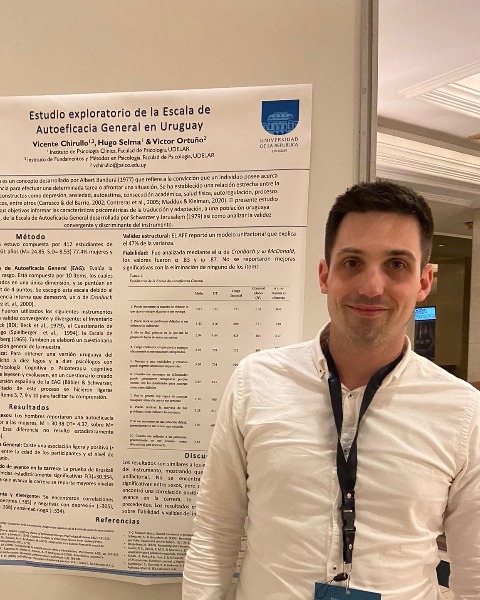
Self-efficacy is a concept developed by Albert Bandura that refers to an individual’s belief in their ability to perform specific tasks or cope with particular situations. Numerous studies have demonstrated strong associations between self-efficacy and constructs such as depression, anxiety, self-esteem, motivation, academic achievement, and therapeutic outcomes. This study examines the psychometric properties of the General Self-Efficacy Scale (GSE) developed by Schwarzer and Jerusalem in a sample of Uruguayan university students. An adaptation was conducted based on the Spanish version developed by Bäbler and Schwarzer. The relationships between self-efficacy and depression, anxiety, self-esteem, temporal extension, and several sociodemographic variables were also analyzed. A descriptive and correlational study with a non-experimental cross-sectional design was conducted. Results indicate that the GSE demonstrates good internal consistency (α = .83; ω = .87) in a Uruguayan university population. Exploratory Factor Analysis replicated the unifactorial structure with high factor loadings (λ > .30) and a total explained variance of 47%, while Confirmatory Factor Analysis showed acceptable goodness-of-fit indices (χ²/df = 3.32, CFI = .97, TLI = .94, WRMR = 1.0). Self-efficacy was positively correlated (p < .05) with self-esteem and weakly correlated with past temporal extension. Negative correlations were found between self-efficacy and depression, state anxiety, and trait anxiety. Sociodemographic analyses revealed differences in self-efficacy according to age, marital status, academic progress, and household size. These findings suggest that the GSE can be used in academic and clinical contexts in Uruguay.